Originally given as part of the conference ‘Devils and Dolls: Dichotomous Depictions of the Child’ at the University of Bristol, 28th March, 2013, this paper was then expanded upon in order for publication in a collection to be published at a later date.
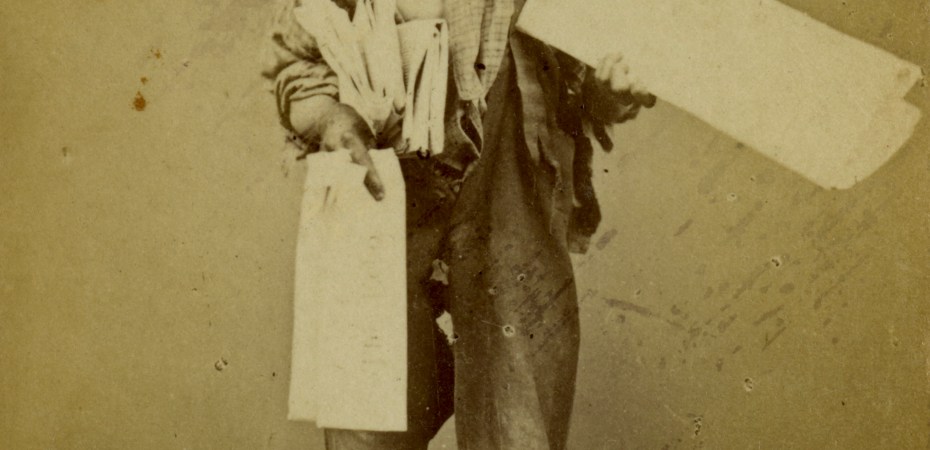
Between the years 1874 through 1905, Dr. Thomas Barnardo had portraits taken of over 55,000 boys and girls upon their induction into his children’s homes. In many cases each child was stripped of his or her clothing, dressed in rags and surrounded by wooden crates and street detritus. They were then photographed in front of a backdrop painted to resemble The images made from these sessions were distributed amongst a class system that had little idea of what it felt to be cold, hungry and without a home, and who responded to them as if they were documents of truth and precision[1].
In a strange twist of fiction following fact, Barnardo dressed up children who had recently come to his homes, often in their best clothes, and taught them to act homeless in order to appeal to a middle class ideal of poverty informed by popular characters of the day such as Charles Dickens’ ‘Little’ Amy Dorrit and Oliver Twist. By the late nineteenth century, the hysteria surrounding child prostitution and homelessness had reached the consciousness of the upper classes. Having disposable income to spend on social concerns showed ones affluence and giving to charity was considered the Good and Christian thing to do so that social pressure from the church meant that philanthropic pursuits were an acceptable way for families to increase their social standing.
Barnardo advertised his charity by exploiting two ideals that were central to Christian Victorian society in the last quarter of the nineteenth century; the inherent belief in the innocence of children and childhood and in the still-new medium of photography as an accurate and impartial truth-telling device. This chapter is about photography and objectivity at the beginning of a new age. It is about the pseudo-science that grew up around the evolution of photography as a social and scientific tool and the strange ways in which the Victorian belief in the inherent objectivity of the camera allowed for constructed fictions to be played out within the public realm.
Following recent progress in institutional photography by Dr. Hugh Welch Diamond and others in the late nineteenth century, Dr. Barnardo made a series of what are now referred to as ‘before and after’ photographs and had them printed onto card stock and sold on the streets to publicise his homes and charities. These images depicted simply, a boy or girl as they had supposedly been found, amid the clutter and filth of the East End and then once again, having graduated from Barnardo’s home as an industrious young adult, accompanied by a juxtaposing theme of suffering and relief such as “Once a little vagrant – Now a little carpenter” and “Singing for bread – Anxious cares are gone”. Throughout these images, Barnardo cleverly suggests a connection between cleanliness and purity, with the Christian narrative of Good and Evil. The implication being, that given a correct Christian upbringing and a good bath, each child could lead a right and spiritually moral life.
Through his magic lantern sermons, Barnardo drew on popular forms of entertainment and spectacle, presenting shocking but entertaining displays, to evoke an emotional reaction that appealed to his audience’s guilt as a way of soliciting support for his charity[2]. This chapter suggests that the various media employed by Barnardo to tell the tale of ‘ragged children’ – from printed pamphlets, pictures, advertising, chapbooks and newspapers as well as the theatre, magic lantern shows and music hall – were inexorably linked through the use of photography, acting as the glue that bound them together, creating a circle of visual representation in which each one referred to another.
One
Upon his arrival in London from Ireland, Barnardo, being an outsider lacking both friends and money, managed to ensconce himself within the genteel world of metropolitan philanthropy, earning himself a place at the Whitechapel Hospital. According to Gillian Wagner’s biography, he existed solely on the skills he brought with him from Ireland; a religious fervor and a way with attracting children and an uncanny ability for persuading people to part with their money[3].
Barnardo gave up dreams of becoming a missionary in China, deciding instead to focus on the social problems in East London after experiencing first hand one of the biggest Cholera outbreaks in London in 1864 in which 5,548 people died. He set up his first Ragged School in a former Donkey Shed in Stepney with borrowed funds. Ragged Schools were at the time intended only as free-schools for poor and destitute children to go for food and education, there were no homes or boarding at the time. According to his self-published periodical Night and Day, Barnardo was taken on to the rooftops of Stepney and Whitechapel by a young boy who was a regular attendee to his Ragged School. Shocked by the rows of children sleeping huddled together under makeshift blankets, Barnardo was inspired to open his first overnight home for waifs and strays in 1870, at the age of just twenty-three. Starting with two cottages for boys and girls in Hope Street, Stepney, these first homes had a restriction on the number of attendees allowed to stay overnight. After a boy who had been refused entry had been found dead the next morning, Barnardo changed his policy, hanging a sign on the cottage doors stating “No Destitute Child Ever Refused Admission”.
Beginnning in about 1870 Barnardo had begun commissioning a photographer to take ‘before and after’ photographs of the children as they had entered his care. These early images, named ‘Entry and Exist’ photographs, referred to an ideology of surveillance technology that by the 1870s had begun to take hold in many institutions in the United Kingdom but most prominently applied to criminals and the insane. Among these could be said to be Barnardo’s photographic department, which had been set up in the first boys’ home in Stepney in 1874. It is listed in the Annual Accounts as ‘Expenses of Apparatus and Chemicals for new Photographing Depertment, and Salary of Photographer and Assistant: £252 13s. 9d’. Unlike most charities, Barnardo’s ran without the aid of a committee, so he was free to use the raised funds as he wished rather than resort to voting. Employing a photographer on salary meant that pictures could be taken like clockwork instead of using a commercial studio or hired photographers as other charities did. Two photographs were taken of each child as they entered Barnardo’s care, albumen prints measuring 7 ¼ X 4 ½ were then pasted into the huge ledgers side by side so that each page carried six double portraits. Siblings that had entered together were photographed together and their names and date of entry were written, often in Barnardo’s own hand, above each image. Below was written a unique catalogue number, that could be cross-referenced with their file, containing past histories and progress notes, often written in Barnardo’s own hand.
Applying photography in this way to children completed a triumvirate social grouping of the unwanted in British society. As John Tagg has pointed out, the local state pulled together “the instrumentalities of repression and surveillance, the scientific claims of social engineering, and the humanistic rhetoric of social reform”[4] in order to maintain a tighter degree of control upon what was considered a threat to English bourgeois society. Photography was the physical instrument used to bring these ideologies together. Due to advances made in chemical and optical science since its inception in 1839, photography was generally believed to be the answer for the need to legitimize the burgeoning pseudo-science of physiognomy championed by Johan Casper Lavater in the eighteenth century.
For centuries the term ‘mechanical’ had long been associated with any labour executed with the hands however, as the Industrial Revolution transformed the nature of manual labour, the term came to refer to any work that was mindless and repetitive, explaining perhaps, why William Henry Fox Talbot chose to name his introductory portfolio of Calotypes, ‘The Pencil of Nature’. Thus, the ideology of the camera was related to drawing almost immediately and the extent to which it would replace the ‘subjective idealisation’ of the engraver was considered in the utmost positive terms. One of the earliest uses of Calotypy[5] as suggested by Talbot was for copying artworks and scientific images – natural still-life such as rocks, fossils and flora, which did not move. Prior to this, scientist and artist shared a somewhat suspicious working relationship – the former battling for pure objectivity over the latter’s “biases”, “fancies” and “judgement”[6]. As the mathematician Charles Babbage stated, what was required of the camera was “a substitute for one of the lowest operations of the human intellect”[7]
Eliza Farnham became one of the first to apply photography to the surveillance of others. In 1846, in the United States, her publication, Rationale of Crime, used engravings made from Daguerreotypes made by Mathew Brady. Her theories incorporated ideas of physiognomy and phrenology, made fashionable by Franz Josef Gall in the early 19th century, which had already set unsurpassable distinctions between lower and upper classes through “zones of deviance and respectability”[8] in assigning skull shape to class and race. Farnham believed that her studies could have a reformative effect on her subjects, but by dividing them according to race, ethnicity, gender, class and age, and by providing commentary upon their skull shapes, she automatically separated them into the ‘type’ of the surveyed and surveilled.
A little later in 1855, Dr. Hugh Welch Diamond, Governor of the Surry County Lunatic Asylum began attempting to take portraits of his female inmates for the purposes of their own rehabilitation. Unlike Farnham, Diamond believed that being involved in the photographic process could inspire his charges to take control of their madness, but despite his efforts he could not convince his sitters to sit still long enough for the required exposure times. His breakthrough came about through a friendship with Frederick Scott Archer, the inventor of the wet-collodion method. Archer confided that he had been developing a photographic process which could be developed onto a glass plate and exposed whilst still wet to the touch, producing a negative with greater definition and durability than Fox Talbot’s[9]. More importantly for Diamond, Archer’s new method allowed for quicker exposure time for capturing human subjects.
Archer’s process created an impression of instantaneity previously thought of as impossible in photography, creating a sense of authority in the scientific community toward the application of photography to science that quickly superseded all other ideas of the nature of objectivity. The notion that a pencil and watercolour executed by a trained artist, could be held to be ‘truer’ than a photograph, became laughable; the relationship between Scientist and artist would be replaced by that of the Scientist and the camera.
A display of Diamond’s photographs, entitled ‘The Types of Insanity, exhibited at the London Society of the Arts in 1852 was deemed hugely successful. A review in the Athenaeum stated that “The Doctor has been enabled to produce a group of portraits of insane and idiotic people who could probably not be induced to remain quiet long enough to be taken by the other processes. This is but one of the many ways in which photography may be made subservient to science.”[10]
His paper to the Royal Society in 1856, listed three possible applications of his photography to the “mental phenomena of insanity”; A.) as a method of treating the physiognomies of the mentally ill for study, B.) of treating the mentally ill through the presentation of an accurate self image, and C.) for documenting the faces of patients to facilitate identification for later readmission and treatment. An article in Journal of the Photographic Society in 1857, stated that:
“There is another point of view in which the value of portraits of the insane is peculiarly marked, viz. in the effect which they produce upon the patients themselves. In very many cases they are examined with much pleasure and interest, but more particularly when they mark the progress and cure of a severe attack of mental aberration.”
Diamond was an advocate of visual imagery as therapy for his patients and these images predate Barnardo’s by nearly twenty years. Diamond’s second point, above, is pertinent to this essay as one might hope that one intention of Barnardo’s images may have been to act a catalyst for change in his young charges or their parents.
Diamond’s efforts would indeed make photography subservient to science though its effects would be felt far more insidiously than he had intended. By this point, the issue of how to maintain social order within the expanding industrialized cities of Britain in the nineteenth century had become an issue of utmost importance. The Industrial Revolution, famine and starvation had drawn many families away from the country in the late eighteenth and nineteenth centuries and as a result most industrialized cities such as Liverpool, Birmingham, Glasgow and London were overrun with crime.
The application of photography to bureaucratic and surveillance technology was generally assumed to be the answer to many of these issues. With the introduction in 1857, by Sir Robert Peel, that all British cities were required to create their own centralized police forces, attempts were made to introduce a generic photographic identification system. Captain James Gardiner, of Bristol Gaol had instituted photography as early as 1847. The periodical All Year Round, wrote in 1873, “it has been the means of procuring sentences of penal servitude for many prisoners whose crimes might otherwise have been treated as first offences.”[11]
After Gardiner, in 1856, William Garbutt of Derby Gaol instituted a register of images complete with descriptions and crimesheets. By 1871, Parliament passed the ‘Prevention of Crime Act’ that required all prisons to adopt photography, and established a central registry of images at Scotland Yard, which, by 1886, held images of nearly 60,000 criminals[12].
“Both photography and classification carried the promise of control over one’s world – control at a time when industrialization, urbanization and mechanization quickened the pace of life – control at a time when it seemed that the world was spinning out of control”[13]
The ways and means by which the state identified and surveyed the criminal body in the 19th century was employed using older ideas of physiognomy and phrenology such as that employed by Farnham whom applied them to photography. The body of the criminal was made into an archive:
“What we have in this standardized image is more than a picture of a supposed criminal. It is a portrait of the product of the disciplinary method: the body made object; divided and studied; enclosed in a cellular structure of space whose architecture is the file-index; made docile and forced to yield up its truth; separated and individuated; subjected and made subject. When accumulated, such images amount to a new representation of society.”[14]
Freed from the subjective idealization of the artist’s hand, the Camera Obscura was finally free to transcribe nature in its most authentic and precise objective detail, but the subjectivity of the operator himself had not been anticipated. In the 1870s, still very much in the early days of his charity, Barnardo had little more than a converted donkey shed to house his children. Prisons were by no means the only state institutions to adopt photography as a means of recording likenesses of their inmates. As early as 1860, Stockport Ragged and Industrial School commissioned a local photographer to photograph staff and pupils, and between 1874-1905 Barnardo’s took around 55,000 entrance and exit photographs[15].
Applying the language of institutional photography and record keeping gave his ‘entrance and exit’ photographs an air of authority and seriousness his burgeoning organization sorely needed in order to appear professional. Yet, these pictures lacked the emotional weight needed in order to attract people to give to the charity to help the increasing number of children turning up at its doorstep each evening. Barnardo saw that dry statistics and preaching of the ‘Moral Good’ were not enough. Even in his earliest published pamphlets he was aware that his message needed to be simple and visual.
Two
Prior to the creation of invention of halftone reproduction in the late 1880s, the common means of transposing the photographic image to printed-paper was to have etches made. One of the earliest such versions of his ‘before and after’ images was `Transformation scenes in real life: effects of the East End Juvenile Mission’, published in The Graphic in 1875. The images had been etched from photographs already taken in his studio in Stepney and here, Barnardo’s awareness of the power of visual imagery over text is clearly evident, though he was still in the process of working through his ideas.
Rather than focusing on dry statistics and stories, the success of the first few images in The Graphic reduce the incredibly complex histories, needs and potential futures of a single child to a simple two-act story that is easily transmitted to the viewer. At this time Victorian’s were only just becoming acclimatised to the day-to-day flurry of visual imagery they were being exposed to on a daily basis. The printed etchings of popular satirists such as George Cruikshank of the late eighteenth and early nineteenth centuries had laid the basis for many of the comic strips that would gain popularity as printed newspapers became cheaper. In these images Barnardo depended upon the Victorian’s knowledge of the intuitive reading format of comic strips and picture plays. Encompassing imagery and text with a sense of cadence and rhythm within a sequence of frames which, when read right-to-left composed a theatrical narrative.
On the page are 4 images, the top half featuring a girl and the bottom half a boy, clearly intended to be read as a pair. Below the girl is typed ‘A GIRL BEFORE RECLAMATION’, hinting at a ‘before and after’ A-B formula. In the first, the power structure of emotion is bound together between viewer and image in this rather clever example of Barnardo’s visual acuity.
The girl, perhaps between 11-15 years old, holds her arms up to her face, looking directly at the viewer, the caption reading: “PLEASE SIR, DO YOU TAKE IN LITTLE GIRLS?” Through this narrative, the viewer takes the emotional place of Dr. Barnardo himself, becoming all that stands between whether this child spends a night on the streets or in a warm bed. In the right-hand image, the same girl is dressed in a maid uniform, dutifully employed upon the task of sweeping up with a dustpan and brush. The implication made, through the one-two cadence of the images, is that the girl is in a better situation as ‘AN INDUSTROUS LITTLE MAID’.
In the next set of images, a boy stands, dressed in rags, with a forlorn expression of helplessness. The text below reads ‘A BOY BEFORE RECLAMATION’ and below that: ‘A STREET ARAB’, one way in which we know this to be true is that his trouser leg has such a large rip that almost his entire leg is visible. In the next image, we see the young boy dutifully employed with a watering can tipped over some shrubbery, below him reads ‘A YOUNG GARDNER’.
The image of the ‘Street Arab’, was one that was widely used at the time to describe homeless boys and proves to be a useful term in discussing the metonymic relationship between imagery and metaphor. The term speaks of a dominant Orientalist narrative that is tied up with romanticised imagery of the nineteenth century based on Imperialism and subjugation. This, in the Victorian Orientalist imagination, denotes exoticism and sensuality but also by implication, represents danger, risk and sexuality. In boys this dual attraction and repulsion is embodied in the narrative of the ‘Street Arab’, but in the girl is embodied by the ‘Harem Slave Girl’, who, like Eve, represented sexuality and knowledge.
Three
Within many of the ‘before’ photographs Barnardo utilised a generally accepted but latent narrative of fear and sexuality within moral Christian society which lay just below the surface of the images in which the torn rags and exposed flesh of young girls represented a very real anxiety about childhood prostitution. As Louise Jackson has pointed out, Victorian society had many euphemisms for young girls who had either been abused or had been forced into prostitution: ‘spoilt’, ‘fallen’ and ‘ruined’, as well as a wide range of euphemisms for the acts that had been committed upon them, such as, ‘corruption’, ‘outrage’, ‘molestation’, ‘indecency’. However no equivalent language existed for abuse that had been enacted upon boys. Jackson believes that the difference lies in a general scrutiny of female sexuality in the Victorian age, which has its basis in the Christian faith and the story of Eve. “Girls and women could be ‘fallen’ but boys, according to Victorian definitions, could not. While special homes were set up for ‘fallen’ girls no distinction was made for boys.”[16]
Within his lantern slide performances using the ‘Before and After’ photographs, Barnardo used visual tropes such as torn rags and a child’s naked skin to shock his audiences into giving to his charity. The proto-cinematic aspect of the Lantern-show was used as a means of education, bringing home the harsh truths of ‘how the other half lives’ to middle and upper class audiences. Ten years later, in the United States, the photographer and Reformer Jacob A. Riis used Magic Lantern slides to great effect in his sermons seeking social reform for tenements in New York’s Lower East Side and his efforts may well have been influenced by Barnardo’s work a decade earlier.
Barnardo appealed to the notions of ‘Good’ and ‘Evil’ that lay at the basis of the Christian faith, both within his lantern slide performances and the ‘before and after’ photographs that he was now publishing and selling on the streets and at his sermons. To the Christian notion of a pure childhood innocence which could be saved from “the rot of degeneration”[17], the notion of purity and cleanliness was never made explicit but was always implied in images, which suggested that the way to salvation started with a hot bath.
In implicating connections between a notion of childhood innocence with cleanliness against a dichotomy of filth and sexuality, through the use of dirty, torn, gender-ambiguous rags and clean, gender-specific uniforms and work-wear, Barnardo cleverly utilised the spectacle of the photographic image and the magic lantern to exploit Victorian sentiment to act as a moral catalyst within his upper class audiences minds.
“Sentiment connoted an overly emotional reaction to social problems that focused on the needs of the individual rather than the common good. Rather than eliciting sympathy by imagining oneself in the place of those in need, sentimental and stereotypical images of the poor prevalent in news sources and in the literary and visual arts fed excessive emotion”[18]
In their article, ‘Caught Napping: Images of Surveillance, Discipline and Punishment on the Body of the Schoolchild’, Eric Margolis and Sheila Fram liken Barnardo’s ‘before and after’ images to those taken of Native American boys at the Carlisle Boarding School, Pennsylvania between 1880-1900. Photographs that were taken as the teenage boys arrived wearing Soux (or Sioux) dress and again three years later as they had completed their ‘acculturation’ into white American society. Here, unlike Barnardo’s, there is no deliberate attempt at staging the images outside of the social codes of the Victorian photographic studio. Where Barnardo equated physical cleanliness with cleanliness of the soul, the change here is represented through the effect of the subjects transformation, becoming indoctrinated into Western civilisation. From wearing typical Soux costume, sitting cross-legged on the floor in one image, to clean white suits and stiff Victorian poses in the next,[19] the power of photography to impart a swift visual message is the same.
In Barnardo’s images the implicit distinction between Good and Bad exemplify and strengthen bourgeois ideals of social order and hierarchy not only for the benefit of Barnardo’s patrons but for the children under his care. Gender and class distinctions are made explicit through the role-play that is embodied in each ‘after’ picture where boys and girls are seen dutifully employed in some kind of domestic or labour position.
The Victorian obsession with the notion of childhood innocence – and by extension with cleanliness – has its roots in the eighteenth century and the teachings of Rousseau. The period in which Barnardo’s media drive was at its strongest coincides with a period of deep mourning in English society for a lost rural past brought about by the industrial age. The metaphor of ‘innocence lost’ in English society was made explicit within paintings such as ‘Penelope Boothby’ and ‘The Age of Innocence’ by Joshua Reynolds in which the idea of innocence was personified as a small child.
Four
During the 1870s, the fervor of nostalgia and sentimentality for childhood was being exploited by companies such as Pears Soap, who took advantage of recent improvements in printing technology to print goods packaging and full-colour advertisements in multiples. Along with his ‘Boy with Bubbles’, John Everett Millais’ ‘Cherry Ripe’ was used in some of the earliest advertising campaigns for the company, which, using the metaphor for cleanliness and innocence through the sale and use of its soap, disseminated an idealized form of childhood into the home that would later be called ‘chocolate-box sentimentalism’.
Before the 17th century there was little understanding as we have today of a childhood that should be cherished as a golden age of innocence. Children were generally thought of as miniature versions of their parents until they were old enough to enter the workforce or help with the family business. Catholicism of the sixteenth century believed that a child was relieved of the burden of original sin once it had been baptized, whereas in Protestantism the Nuremberg Catechism preached that even in the womb, children had “Evyll Lustes and Appetites”[20]. Protestants and Puritans taught their children catechisms – lessons in religion, the knowledge of which was believed to ensure the child’s soul entry into heaven – which they were then required to reiterate to their parents in gruelling question and answer sessions sometimes lasting hours[21]. The repetition of Catechisms literally taught the child to become an adult from an early age and to behave as their adults did.
Despite these strong symbols of family unity, paintings at this time often depicted the children as miniature adults, literally shrunken versions of their parents. In the family portrait ‘Ladies Celebrating the Birth of a Child, and Gentlemen Looking on from Behind a Screen, In an Interior’ by Hieronymous Janssens (1624-1693), the newborn baby is depicted as a child’s doll, held aloft by a wet-nurse, while the young children are shown wearing the same clothing and acting in the same manner as their adult counterparts. Paintings such as ‘A Family in an Interior’ by Jan Olis (c.1610-76) were used as symbols of wealth and reputation and through these the reputation and future of the family were seen as more important than the individual need of the child.
Under the influence of the Enlightenment, pictures of children gradually began to change. Elite painters in the British Academy such as Joshua Reynolds, Thomas Gainsborough and Henry Raeburn began to depict children less as their future adult roles would indicate but more as a state to be enjoyed and indulged in, as a new appreciation of childhood, free from adult faults, social evils and sexuality became prevalent. Many of these artists were influenced by the writings of Jean-Jacques Rousseau’s text Emile (1762). Rousseau, who lived in England between 1765 and 1767, was sceptical of the traditional religious teachings of the time, declaring that “childhood is unknown.”[22] He suggested to parents that they raise their children as gently as possible, with toys and games, in simple, loose clothing rather than the heavy, ruffled coats of the period. Rousseau taught that “the first impulses of nature are always right, there is no original sin in the human heart, and the how and why of every vice can be traced”[23]
By the 1780’s Joshua Reynolds, as the president of the Royal Academy, was spending his free time painting children. He often painted beggar children from the streets of London who he would entertain with stories and games. Unlike his contemporaries who would whip their young models in order to keep them still, Reynolds sought to capture the natural expressions that came from a child’s delight at being entertained rather than directing them in how a child ‘should’ look.
In the painting by Reynolds known as ‘The Age of Innocence’, there is a focus on the child as an individual outside of its relationship to the adult world. Upon its purchase, the National Gallery changed its original title from ‘Portrait of a Girl’, reflecting perhaps, the changing attitudes towards the way in which society was beginning to view its youth. The identity of the little girl has been lost in time but during this period, Reynolds’ also painted ‘Portrait of Penelope Boothby’, which further heightens the focus on the child as a melancholy, pensive air is captured as the child appears lost in thought. Just one year after her portrait was painted, young Penelope Boothby took ill and died. The melancholy air of the painting and the knowledge of the sad true story seems to have caught the imagination of the public who seemed to wallow in her tragedy and the portrait that, at least, captured her in her innocence.
Reynolds portrays his young sitters, their attention held by something other than the viewer, as “having no class, no gender and no thoughts – of being socially, sexually and psychically innocent.”[24] For once these children have nothing to prove, no estate or lineage to uphold, as Reynolds allows them for the first time, to be children – to be absorbed by childhood. Later on, both Dickens and Millais would subvert this idea by placing the child as metaphor in the threatening surroundings of Industrial London.
By the early part of the eighteenth century the National Gallery had opened in Trafalgar Square between the wealthy West End and much poorer East End so as to be accessible to all classes. As the availability of the technology became more democratized so too did the notion of innocence, so that soon all people could afford the portrait of the little girls ‘Penelope Boothby’ and ‘The Age of Innocence’ printed onto card. 323 versions were made and reproduced of ‘The Age of Innocence’ at the time, reflecting the fervor for the representation of childhood and innocence in art.
By the late nineteenth century, Boothby fever had truly caught the public imagination. In 1886 Charles Dodgson, otherwise known to the world as Lewis Carroll, had photographed one of his child models, Xie Kitchen, dressed as Penelope Boothby. In 1880, William Luson Thomas, the publisher of the London newspaper The Graphic, which had published Barnardo’s first ‘before and after’ images five years earlier, commissioned John Everett Millais to paint a portrait of his grand niece in costume, after she had attended a fancy-dress ball as Penelope Boothby. Luson included it as the centrefold for the Christmas edition, calling it ‘Cherry Ripe’. It was an immense success and in 1881 was reproduced as a mezzotint and sold through the newspaper, selling 600,000 copies within a few days[25].
The notion of childhood innocence, to be cherished, saved and protected against the evils of the world, became synonymous with a desire for a return to a simpler time. The success of ‘Cherry Ripe’, regardless of what more modern interpretations make of it,[26] is reflected in what people saw as a nostalgic return to “an England for which the clock had stopped before progress had exacted its emotional, psychological, and social price”[27]. The popularity of Millais’s ‘Cherry Ripe’, with its evocation of Reynolds, a revered master of English art history, demonstrated the necessity, felt by many Victorian painters to reach into the past in order to forge reassuring images for the present.[28]
The metaphor that the romanticised child stood for was both political and poetic. The child was everything the sophisticated adult was not. Everything the rational man of the Enlightenment was not. “The child was figured as free of adult corruptions; not yet burdened with the weight of responsibility, mortality, and sexuality.”[29] By the latter part of the nineteenth century, many forms of media and advertising played on and exploited the burgeoning and ever evolving ideas of innocence and sentiment among Victorian society. Among these could be said to be Barnardo’s photographic department, which by 1874 was producing and selling his ‘before and after’ publicity photographs. Three years later, Dr. Barnardo had been forced to cease their production.
Five
The varied accusations that flew around Barnardo and his charity in the mid-1870s were in essence a ‘turf-war’ between various evangelical preachers. Barnardo, being young and one of the most successful, received the brunt of what were initially anonymous smear campaigns. Among other things, he was accused in the East London Observer and The Record of practicing as a Doctor before he had graduated (the medical act of 1858 had made it illegal to assume medical status without being registered) and of exaggerating the effects of homelessness on the children he had had photographed in order to demonstrate how much their stay in his homes had benefited them in order to fund his own lifestyle.
Particularly widespread in the East End were ‘charities’ that existed solely to exploit the trend for social and child welfare. In order to counter this, the Charity Organisation Society (COS) was set-up to discredit the many fraudulent charities that existed in London at the time. The COS worked much like a union seeking to bring together the various evangelical groups in the East End and put a stop to the infighting. From the beginning, Barnardo’s success in the East End and his determination to remain independent of any organisation had caused the COS to regard him with suspicion.
What had begun as simply competitive rivalry between Barnardo and a Baptist minister named Reverend George Reynolds had, around the same time, become a bitter feud, with each denouncing the other both in their street sermons as well as in low-quality, anonymously published pamphlets. Many ministers and preachers employed false names to attempt to sully the reputations of one another during this time, though whether this out of cowardice or in order to appear to reflect popular opinion is unclear. Reynolds’ level of jealousy became a matter of personal obsession and in November of 1876 he published and distributed his accusations against Barnardo under his own name. Reynolds aggressive tactics worked and as the public became wary of Barnardo’s work, support of his homes began to wane. Incenced at Barnardo’s refusal to join their ranks, the COS approached Reynold’s discretely, asking him to find evidence of illegal activity by Barnardo, which could be taken to arbitration in a criminal court.
By 1877 Reynold’s and the COS had collected enough evidence to be brought before the court to issue a warrant to arrest Barnardo on a number of charges. Many of the accusations made against Barnardo, if not entirely true, had at least some basis in fact. The part played by the COS in Barnardo’s trial and their involvement in the charges against him were, at the time, concealed by the COS and their involvement with Reynold’s was vehemently denied during proceedings. In her biography of Barnardo, Gillian Wagner states that:
“It has always been assumed, as the COS wished it to be assumed, that as charges against Barnardo had been made it was the duty of the COS to investigate those charges.”[30]
One of the main charges brought against Barnardo by the court was that he was operating illegally as a Doctor and had forged a Certificate from Giessen University awarding him a Medical Doctorate. One of the main issues that arise out of the transcripts of Barnardo’s trial is a sense of outrage by general society at having been tricked by Barnardo’s use of Photography. This highlights a very real sense of anxiety in the general public at not being able to ‘trust ones eyes’ anymore. Barnardo’s defense was that he was acting for the benefit of the ‘Greater Good’ of his charitable work and in doing so reverted to the same ‘Higher Truths’ that much of the popular humanitarian reform literature of the day had depended upon, exemplifying this in other forms of media outside of his photographs also, in the form of chapbooks, prints and magic lantern shows.
While many charges against him were found to be either untrue or exaggerated, the court decided that “excessive artistic license” had been used in the ‘before and after’ photographs and that, even if no physical evidence of abuse could be found, the innocence of the children in question had been abused.
“The system of taking, and making capital of, the children’s photographs is not only dishonest, but has a tendency to destroy the better feelings of the children… He is not satisfied with taking them as they really are, but he tears their clothes, so as to make them appear worse than they really are. They are also taken in purely fictitious positions.”[31]
It is entirely possible that Barnardo truly believed in the power of the image as visual metaphor or pun and that the ‘Higher Truth’ embedded in these images would be apparent to the viewer. However, his mistake lay in how visually acute he expected his audience to be. At this time, the line between fiction and fact was often blurred by many Evangelicals, who incorporated what they saw as ‘Higher Truths’ within their pamphlets and chapbooks. By dressing the grim reality up in fictions they hoped to make the truth more palpable for their upper and middle class audiences. Today these are referred to as humanitarian reform literature. One example, which purported, like Barnardo, to expose the truth while simultaneously acknowledging that artistic license had been taken is ‘Following Fully’ (1872) by Anna Shipton, who wrote in the introduction; “I cannot but regret, that fiction should in any way mingle in this brief narrative, which I have endeavored to use as an illustration of following the Lord fully”. Another is ‘Dusty Diamonds Cut and Polished’ published in 1884. It was one of many novels that sought to depict the real lives of London’s street children and the attempts made by various charitable organizations to save them, but it was generally known that author R.M Ballantyne had used many of the facts of Barnardo’s own life, which he had already written about in his Night and Day newsletter.
Such books fulfilled an unconscious desire within the upper and middle classes to be at once shocked and titillated by the supposedly ‘true confessions’ of poor working-class families amongst London’s East End. Barnardo pulled off the trick of conflating the Victorian upper middle class philanthropic desire with its desire for titillation.
At this time the prescient issue of child homelessness, prostitution and slavery had been exploited by chapbooks that were printed in the fashion of humanitarian reform literature such as ‘Uncle Tom’s Cabin’ (1851-52) by Harriet Beecher Stowe and ‘Two Years before the Mast’ (1840) by Richard Henry Dana, Jr. Karen Halttunen makes the point that the literature of humanitarian reform, with its many graphic representations of terrible cruelty and suffering, was “embedded in a tangle of apologies, explanations, indirections, and bowdleristic omissions”, which revealed the authors complicity within a network: “Apologise though they might, the reformers were caught up in the same cultural linkages of revulsion with desire that fueled a wide range of popular literary explorations of pain.”[32] The literature of humanitarian reform became an industry unto itself, creating a circuitous machine of pain and shame that its readers revelled in. Similar works that explores corporal punishment upon children include ‘Evil Tendencies of Corporal Punishment’. Its author, Lymann Cobb wrote; “I have often seen both parents and teachers flog their children or pupils until my whole soul was shocked and disgusted”[33] In much of the literature that pertains to the suffering of children at the hands of corporal punishment, the emphasis is always on the emotions of the author or protagonist as if to justify the image of violence which they then paint. This is the experienced vicariously by the reader. In much the same way Barnardo could be described as using a visual equivalent in his images and Magic Lantern sermons, exploiting his audiences emotions. In a way which Haltunnen refers to as ‘the pornography of pain’ Barnardo;s images play on the readers attraction to their own heightened emotional state caused by viewing the suffering of children.
Unlike Humanitary reform literature, where the reader experiences the emotions second-hand, Barnardo used the still-new language of objective scientific photography to show this to his audience of supporters and donors. As far as they were aware, what Barnardo’s audience was viewing was documentary evidence of childhood experienced in the slums of the East End. A decade later, pioneering the use of indoor flash, Jacob A. Riis managed to genuinely shock his middle class patrons, into recognizing the harsh realities of slum life in New York City with his book entitled How the Other Half Lives.
Six
From printed pamphlets to photographs on card to printed advertisements to Magic Lantern shows and sermons – Barnardo utilised a clever visual language, the complicity in and enjoyment of which his own audience became part. Like all Evangelical Missionaries, he developed a relationship with his audience in which they trusted him implicitly to tell – and to show – them the truth. The general belief at this time in the ability of the camera to deliver statistically sound, trust-worthy information was belied by a desire to be entertained and thrilled vicariously despite many obvious indications to the contrary.
This chapter has explored the idea of photography and objectivity at the end of the nineteenth century. It has been about the pseudo-science of institutional photography, which grew up around the evolution of photography as a social and scientific tool and the strange ways in which the Victorian belief in the objectivity of the camera allowed for constructed fictions to be played out within the public realm. As John Tagg has written, what gave photography its power to suggest the truth “was not only the privilege attached to mechanical means in industrial societies, but also its mobilization within the emerging apparatuses of a new and more penetrating form of the state.”[34]
Photography carried with it the scientific credentials of ‘Objectivity’ and ‘Truth’, which gave it a free pass when entering the music hall and vaudeville, carried by the likes of Barnardo and Riis. Employing the language of institutional photography gave Barnardo an air of authority and sense of trustworthiness in seeking funds for his charity, while his sermons enabled his audiences to go ‘slumming’ and satisfy their touristic curiosities while at the same time making them feel virtuous for being ‘moved’ by the horrors they observed at a distance[35], creating what Daniel Czitrom has called the “Vaudeville of reform”[36].
Around this time the pre-cinematic interest in the Magic Lantern show was gaining popularity outside of the restrictions of the Evangelical Missionary sermons, expressing a pre-cinematic desire in the audience to not only be entertained, but to be fooled and tricked. By the turn of the century, due to prevalence of printed ephemera such as advertising and photography, Edwardian audiences were becoming more visually acute. Soon, the works of the Meliés Brothers from France were entrancing, shocking and most importantly, fooling audiences with films such as ‘Train Arriving at a Station’ and ‘Trip to the Moon’ and audiences in return, could not be happier to be fooled.
Starting with his humble ‘before and after’ photographs in 1874, Barnardo appealed to Victorian attitudes toward the young to promote the work of his charity utilising a discourse of salvation and labour which reflected the Victorian values of hard work and temperance. Beneath each image were a set of subtitles that reinforced the Alpha-Beta Christian Missionary narrative; that dirt and sex are sin and cleanliness is virtue and chastity. Through this he continually repeated the motif of the child within a dichotomous framework of Good and Bad that could find salvation through hard work. By 1877 and as a direct result of the trial, Barnardo had ceased sales of the ‘before and after’ photographs to the public and thus resorted to more creative tactics to engage prospective donors. By the 1890s, however he had changed his sales pitch entirely and was aiming big. At his Annual Meetings at the Albert Hall, Barnardo increasingly employed an Empirical discourse of mass production in his ‘Living Illustration’ performances. Each year he presented his children as a commodity to an audience of potential buyers eager to invest in the future of the British Empire with the explicit intention to show the economic use to which they could be put. Barnardo struck a deal with the Canadian government and by 1905 had sent 118,000 children to populate the developing commonwealth country.
Today, Dr. Thomas John Barnardo’s own visual acuity and ability to ruffle a few feathers still serves as inspiration in recent advertising campaigns. Computer generated or photoshopped images, showing babies with coakroaches and hyperdermic needles in their mouths and child prostitutes, old before their time continue to utilise the power of photography to highlight the still very real risks to childhood in the modern world and to shock its audience into giving generously to the charity.
Footnotes:
[1] To borrow a phrase from Joan M. Schwartz.
[2] Lamuniere, Michelle ‘Sentiment as Moral Motivator: From Jacob Riis’s Lantern Slide Presentations to Harvard University’s Social Museum’, History of Photography, 36:2 (2012), p. 138
[3] Wagner, Gillian, Barnardo, London : Weidenfeld and Nicolson, 1979, p. 29
[4] Tagg, John, ‘The Burden of Representation: Essays on Photographies and Histories’, London, University of Minnesota Press, 1993, p. 84
[5] Talbot’s term, derived from the Greek, meaning ‘beautiful impression’. His friend Sir John Herschel would later coin the term ‘photography’, meaning ‘light drawing’.
[6] Quoted in; Dalston, Lorraine and Gallison, Peter, ‘The Image of Objectivity’, Representations 40 (Fall, 1992), p.169
[7] Quoted in; Objectivity, p.138
[8] Sekula, Allan, “The Body and the Archive”, October, 39 (Winter, 986), p. 35
[9] Archer’s Wet-Collodion method would eventually be used in the Tintype and Ambrotype, which became hugely popular in the United States in the early 1860s.
[10] Quoted in; Pearl, Sharrona ‘Through a Mediated Mirror: The Photographic Physiognomy of Dr Hugh Welch Diamond’, History of Photography, 33:3 (2009), p.289
[11] Quoted in Popple, Simon ‘Photography, Crime and Social Control’, Early popular Visual Culture, 3:1 (2005), p. 100.
[12] Popple, Simon ‘Photography, Crime and Social Control’, Early Popular Visual Culture, 3:1 (2005), p. 95.
[13] Schwartz, Joan M. “Records of Simple Truth and Precision”: Photography, archives and the illusion of control’ Archivaria, 50 (2000), 36.
[14] Tagg, p. 60
[15] Popple, p.95
[16] Jackson, 108
[17] Jackson, Louise, A., ‘Singing Birds as well as Soap Suds: The Salvation Army’s Work with Sexually Abused Girls in Edwardian England’, Gender and History, Vol. 12 No. 1, April 2000, p. 107
[18] Lamuniere, p.138
[19] Fram, Sheila and Margois, Eric, ‘Caught Napping: Images of Surveillance, Discipline and Punishment on the Body of the Schoolchild’, History of Education, Vol. 36, No. 2, March 2007, p.193
[20] Cunningham, Hugh, The Invention Of Childhood, BBC Books, London, 2006, p.66
[21] Higonnet, Anne, Pictures of Innocence: The History and Crisis of Ideal Childhood, Thames and Hudson, London, 1998, p.25
[22] Rousseau, Jean-Jacques, Emile or On Education, tr. Allan Bloom, New York, Basic Books, 1979, p.33
[23] Rousseau, Jean-Jacques, The Social Contract, tr. G.D.H. Cole, London, Dent, 1993, p. 45
[24] Higonnet, Anne, Pictures of Innocence: The History and Crisis of Ideal Childhood, Thames and Hudson, London, 1998, p.24
[25] Cunningham, p.68
[26] See Bradley, Laurel. ‘From Eden to Empire: John Everett Millais’s Cherry Ripe’ Victorian Studies 34 (1991), pp. 179-203 and Kincaid, James R, Erotic Innocence: The Culture of Child Molesting, Duke University Press, Durham and London, 1998 and Polhemus, Robert. M, ‘John Millais’s Children: Faith, Erotics, and ‘The Woodmans Daughter’’, Victorian Studies 37 (Spring 1994), pp. 433-450.
[27] Bradley, p. 189
[28] ibid p.180
[29] Kincaid, James R, Erotic Innocence: The Culture of Child Molesting, Duke University Press, Durham and London, 1998 p.15
[30] Wagner, Gillian, Barnardo, London : Weidenfeld and Nicolson, 1979, p.29
[31] Quoted in Lloyd, Valerie and Gillian Wagner, The Camera and Dr. Barnardo, Hertford, 1974, p. 14.
[32] Halttunen, p. 330
[33] Halttunen, p. 326 (my emphasis)
[34] Tagg, p.60
[35] Lamuniere, p.144
[36] Quoted in Koven, Seth, Slumming: Sexual and Social Politics in Victorian London, Princeton, N.J. : Princeton University Press, 2006, p.64
 Gavin Francis Maitland