
This paper was originally given at the Archives 2.0 Conference, National Media Museum Bradford, November 2014.
In 2013 Terry Cook published his final article in the pages of Archivaral Science shortly before he passed away after a long and influential career at the National Archives of Canada. His writing in the pages of Archivaria and Archival Science, especially during the Total Archives debate of the 1980s was especially influential toward a consideration of social photographs as archival material. He announcement, as a kind of Swansong, of a new Archival Paradigm for the 21st century was greeted with enthusiasm if little surprise by the archival community who have been working around the various freedoms and restrictions the internet has bought to the industry throughout the last fifteen to twenty years.
In his paper, titled, Evidence, memory, identity, and community: four shifting archival paradigm, Cook stated that the general theme of this new age would be that of ‘Community’, identifying this not as a “fully formed paradigm, to be sure” but one that suits the “social ethos, communication patterns, and community requirements of the digital age” that have been brought about by an increase in web use and acuity[1].
Terry Cook identified each paradigm as vaguely covering a period of Western archival history of the last 150 years in four phases; “from juridical legacy to cultural memory to society engagement to community archiving.”
He went on to define each of these as exemplifying a set of “Key Concepts”: The first of which; ‘Evidence’, he identified as lasting until the 1930s. It valued the juridical concepts of constitutional, legal, military, and foreign relations and national and international activity over any local or regional activity. The second, ‘Memory’, was concerned with state records while appraisal and selection techniques were introduced as more consideration was placed on the social, cultural, economic, and scientific activities of the state, and thus an emphasis on “History from the bottom up.” By the 1970s, with an increase in social and political grassroots organizations and legal rights of individuals over corporations became more accepted, the third paradigm, named ‘Identity’ came into focus.
As Cook and Joan Schwartz have previously discussed – for centuries, archives had previously been a symbol of governmental power, based on concepts of ‘Truth’ from the top down. Increase in understanding in the language of the internet has brought about a “democratization of archives” in which community organizations, inspired by social activism and community archives set-up in the 1970s and 80s, are using digital and web technologies in order to enable a more participatory and collaborative archival practice that engages with the society and culture around them.
Certainly in the last decade the development of web and digital technology has been changing the way we as the public utilize our archival and museal holdings for research, and community activist/archivists have had a lot to do with this. The last few years have seen a wide range of research projects charged with investigating the use of digital technologies by archives and communities in the UK and include the AHRC funded ‘Connecting Communities’ project, based at Leeds University which was funded under the ‘Digital Transformations in Community Research Co-Production in the Arts and Humanities.’
Almost anticipating this, Cook stated in his paper:
“With the Internet, every person can become his or her own publisher, author, photographer, film-maker, music-recording artist, and archivist. Each is building an online archive. So, too, are countless nongovernmental organizations, lobbying groups, community activists, and ‘‘ordinary’’ citizens joining together, in numerous forums, to share interests reflecting every possible colour, creed, locale, belief, and activity, actual or hoped for. And they are creating records to bind their communities together, foster their group identities, and carry out their business.”[2]
As one blogger and community archivist has recently stated “There must be something in the air…I thought I was doing it for the love of it, but it turns out I’m just a child of my time.”[3]
———–
However, tellingly absent from this flurry of enthusiasm appears to be much focus on the use of digital communications technology in conjunction with photographic archives. As a photographic historian and archivist I find this surprising since most websites for archives and museums use their photographic holdings to describe and illustrate their various other holdings yet they barely focus on these photographic riches. What is even more glaring is the lack of any attention towards what can variously be described as snapshot, family, vernacular or social photographs that I would like to refer to here today: the everyday photograph that all of our families own and have taken prior to the digital revolution.
The scope of this essay does not allow for a detailed discussion of archival terminology or discussions around born-digital formats or web-only archives. This paper simply attempts to act as a jumping off point for ideas and to initiate a conversation about what could potential be done to remedy in the future. To illustrate I provide my own family photographs as well as images I have collected over the years. This paper does not so much strive to give any easy answers as to how snapshot photographs can be utilized by archives today, or in the future, and I am aware that it is a vast and complicated question, however I hope that, by sharing my enthusiasm with you here today I might encourage other archivists to think about ways in which the archival community can come together for photography in the same way it is doing so for other more traditional forms of documents.
As Robert Flynn Johnson has written; “below the surface of established fine-art photography is a vast, unwieldy reservoir of untapped visual images… They are waiting to be discovered and transformed from trash into visual treasures by those willing and able to seek them out.”[4]
———–
In recent years popular culture has experienced an explosion of interest in vernacular photography and its application as a creative tool. As Nancy Martha West has stated, found photographs “invite a retelling of the story.” From websites such as the fashion Blog My Mom the Style Icon to literature such as the Miss Peregrine’s Home For Peculiar Children series which the author uses rather creepy-looking found photographs as a rather serendipitous way to form his narrative structure.
Yet for years photography as a form of cultural expression was informed by the art-historical mode of value-based collecting that came about in the late-nineteenth and early twentieth centuries based on a bourgeois formula for the accumulation of wealth in the New World. This was authorized by curators and writers such as Helmut Gernsheim and Beaumont Newhall in the thirties and forties who canonized certain photographers over others based on social and personal preferences, creating a long cemented obsession with individual genius over societal and scientific advancement. Vernacular or Snapshot photography, if it was considered at all, was thought of, as ubiquitous and ephemeral as old coins or a comfy old sofa. Useful and necessary perhaps, but nothing anyone would proclaim as a work of art.
Although, Newhall touches on Victorian ‘Amateur’ photography of the upper-middle class semi-professional variety and gives a couple of pages to George Eastman and Kodak, mention of snapshot photography as an empowering social movement is largely left out of the historiography of Photography for practical reasons. As a renewed enthusiasm for research into the history of photography emerged in the 1980s, a focus on the beauty of the Daguerreotype both reset and continued the old art-market value-laden model of the past with a focus on ‘Masters’ of photography such as Southworth and Hawes in the U.S. and William Edward Kilburn in the UK.
What followed, especially in the United States, is of an interest in vernacular or snapshot photography as an antidote to the traditional value-based, art-historical model of photography which tends to emphasize individual genius and monetary worth over social or cultural revolutions. During the 1990s and due in part to the cheapness and ubiquity of snapshot photography and the early days of blogging – Ameicans began to buy up their history and put it to new creative uses. As Douglas R. Nickel has stated; “When … the snapshot is severed from its original, private function, it also becomes open, available to a range of readings wider than those associated with its conception.”[5]
Cook’s call to power for community archives comes then at a time most pertinent for the study of the history of photography.
The Materiality of Photography
One argument for the archival value of snapshots is their influence on our modern self-image. Many historians have argued that the way we see our selves in modern society is inextricably linked to the ways we represent ourselves, photographically. This may sound obvious, but that is the very problem in our discussion of the snapshot in the history of photography and of Western culture – they are/were so ubiquitous that it was hard to separate what they do critically from our everyday experience of them. Oliver Wendall Holmes best summed up photography when he compared it to a form of currency, like the banknote, while even in the 1970s Michael Lesy was an early advocate of snapshots valuable archival documents saying;
“… I’d claim that the use of photographs as data was of the most remarkable importance for the humanities and social sciences… that it was a thing made to achieve an end like a letter, or to be an end to itself like a poem; that, in either case, it was tangled within a whole culture that was itself pinned within a social structure…”[6]
The Dagguerreotype though expensive in the first few decades of its existence, nevertheless constitutes the first form of democratic and social portraiture. It was generally just big enough to carry about, given as a gift, shared and shown around. It was held within a gutta percha case and lined with felt, creating a sense of solidity and materiality since lost in the evolution of social photography. The casing was necessary to protect the incredibly sensitive surface from damage, but inadvertently created an object that even now, invites holding, caressing and gazing.
Now, many people know of this image as the cover of Susan Sontag’s book ‘On Photography’, yet she gives it no space within its pages. To me the iconic reflexivity of this image is due to its double nature. It is a beautiful image on its own, yes. But it also says so much about the nature of photography and of family photographs in particular. In it, we have a couple staring longingly in to the camera lens, whilst holding another Daguerreotype of a young family, possibly their own children. Perhaps they have left their family behind while they make a new life for them all in the New World. We will never know for sure – their story is lost to us. This image is idiosyncratic for its time in that it says spells out so much about the indexical nature of photography, recalling Roland Barthe when he said that the photograph is indexical in nature in that it is “literally, an emanation of the referent.”
This reminds me of an apocryphal tale I once read somewhere of a young photographer in the 19th century who, one day had a very elderly gentleman come in to his studio. The gentleman’s wife had recently died and he had with him a collection of her clothes. He wanted the photographer to make him a picture of his late wife so that he could see her again and, in his grief believed the photographer to be like a magician or alchemist, being able to make something whole again out of a few scraps.
This is what photography does. It brings the dead to life and transports us back to a time when we were spiritually complete. The family unit.
In a Freudian sense a photograph is a fetish in that it repairs or completes a part of us that is missing and it has been proven to have a restorative effect upon the nature of grief. So why do we give so little credence to these things that are so ubiquitous? Perhaps it is their very ubiquity that hides their importance from us and that is the issue in archival practice. How do we begin to quantify so many images that come with no meta data and rarely any form of provenance. They mean little to us as archivists unless they happen to feature a person of note – or to have entered the archive within the fonds of a larger collection – again usually pertaining to a person of note. But why does it have to be this way?
And, just why do I care so much about this? As someone who works both as a researcher of British social history and an archivist, I see a distinct lack of care for our own heritage in photographs. I have always been a fan of snapshot photographs. When I was a kid my Mum kept all of our family photographs in one big box – all jumbled together and my Brother and I would spend hours piecing these fragments together. Coming from an Italian background I was fascinated that my Grandmother came from a different country to the one I knew and that she cooked the food for us that she had learnt from her Mother and Sisters. Snapshot photographs are powerful, beautiful things because they tell us stories, they tell us where we come from as individuals and who we were as a society. And, besides, as William Butler Yates has said;
“The history of a nation is not in parliaments and battlefields, but in what people say to each other on fair days and high days, and in how they farm, and quarrel, and go on pilgrimage.”
Over the last few years I have become aware of an already large and growing number of books relating to the American Snapshot, which, informed as they are by popular culture and movies, have the sparkle of Nostalgia and exoticism about them compared with what many perceive as our rather drab and boring British counterparts. There seems to be a general malaise around the rediscovery of snapshot images in the UK; an idea that persists in contrast to the exoticised foreign nostalgia of American snapshots. Since I’ve been collecting and compiling photographic collections I have come across many snapshots and entire photo-albums that consistently disprove this idea.
Again I ask myself, why do I care about this? Perhaps I fancy myself, arrogantly, as Nancy Martha West, has written, as “an explorer of uncharted territory, “rescuing” objects that even other connoisseurs of the past Choose to ignore.” While much of the creative uses of snapshot photographs are predicated upon their anonymity, I think it may be the Archivist/Activist in me that seeks to save these images for the truth that they contain rather than for their potential fictions. Perhaps it is true that, as West has written, “intimate associations with personal memory make the poignancy of their neglect that much richer.”[7]
D.J. Waldie summed it up best when he said; “Found snapshots are trivial… but they’re bodies too, just like you and me, and they have nowhere else to go but into someone’s hands or into the furnace.”[8]
————-
By the 1880s, with the creation of a dry colodion preparation, faster lenses and the establishment of dedicated photographic specialists such as George Eastman’s Kodak things changed at a rapid pace for snapshot photographs. Eastman was a man with a vision, seeing a great democratic vista in which everyone could master the art of photography with the simplest of ease. He went about buying up chemical and mechanical patents, combining them, ever tinkering and perfecting, releasing newer models of camera that were always a little more compact, a little simpler than the last – until he released the Kodak No.1, a camera so simple, he claimed, that a child or even a housewife could use it. In maintaining what Sontag calls the’ Whitmanesque imperative’ of photography, Eastman revolutionised the way photography was marketed and distributed and enjoyed by the public. In offering photography as a whole package, with the processing of film being taken, literally out of the users hands, allowed for the first time, that the user did not need have any prior knowledge of chemistry or developing techniques and little to no artistic pretensions. However, given its equivalent £400 price tag, the Kodak No.1 was not affordable by many but the middle and upper classes[9].
———-
Here I would like to introduce one such family who were able to afford and utilize the Kodak No.1 to capture a little seen aspect of private middle-class life at the end of the 19th century and to suggest some ways in which this particular example might be put to good effect via web technologies. Three albums of circular photographs were collected as a part of the huge Kodak archive from Harrow in the 1980s into Bradford’s National Media Museum. They are particularly notable because they serve as some of the only intact, British examples of the use of the short-lived Kodak No.1 by a single person or family.
James Thursfireld was born in Kidderminster and educated at Corpus Christi College, Oxford, graduating in 1863. In 1881, he was employed by the Times as a naval correspondent and soon established himself as an authority on such matters lecturing and publishing several books. He was married to Elizabeth in 1880 and had two children, a boy and a girl. His son, Henry George Thursfield would follow his father, becoming naval correspondent for the Times from 1936 until 1952.
Upon his retirement from active press correspondence in 1891 Thursfield rewarded himself with an extended holiday, taking in Morrocco and Algiers with his Elizabeth. Before departing he purchased the brand new Kodak No.1 and which Thursfield, who lived behind the British Museum, probably purchased in person from the nearby Oxford St. Kodak shop in anticipation of his twilight Grand Tour.
Thursfield begins by carefully and methodically documenting his home, 11 Montague Place in the upmarket area of Bloomsbury. He takes pride in documenting his family, going as far as taking down a recently commissioned portrait of his wife from the wall, positioning it on a couch in order to take a better picture. He takes portraits of his children and his friends out on the balcony overlooking Montague Place. However, he annotates these snapshots with a cold, detached air unfamiliar to us of later photo-albums. By simply referring to his children and friends by their initials or surnames, Thursfield demonstrates a coldness and separation that betrays the closeness and warmth of these images, rarely depicted in late-Victorian family photographs. However As if Thursfield himself is caught between his own early-Victorian upbringing and the coming surge of modernity, which, through technology, will bring us all closer together. In the only image of James Thursfield himself, perhaps taken by one of his children, he is depicted in the ‘straight’, rigid style of early Daguerreotypes – gaze averted over the rooftops of London, arms folded, rigid, detached.
————–
So what ways can we begin to think of this album in the context of archival practices and new media? If we look at some other successful examples of social photographs being re-dispersed and gaining new lease of life through web technologies, perhaps we can start to get an idea:
Edinburgh Libraries Capital Collections website and Our Town Stories are excellent examples of what can be done by combining various technologies. They have created a range of interactive ‘stories’ of the lives of Victorians and Edwardians in and around the city of Edinburgh utilizing primarily their photographic collections. On the Our Town website you can navigate through the late Victorian childhood of Florence Morham whose Father was a successful architect and keen amateur photographer. Interactive maps and ephemera as well as well researched family history frames the beautiful images.
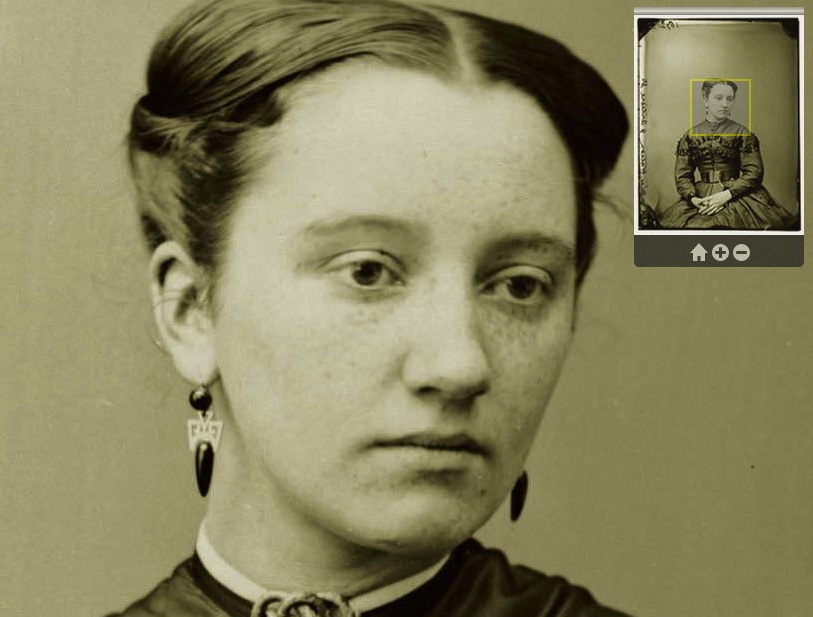
On the Edinburgh libraries page is the work of David Doull who ran a successful portrait studio in Edinburgh during the late 1860s. His huge collection of 319 glass-plate negatives were bought by Edinburgh libraries in the 1970s and have only just gone on display on their website.
50 of the plates are lovingly reproduced in positive and full plate showing annotations and sitter information in the frame. Archival information is reproduced along with well-researched biographical information on the sitter, but, in the ability to focus in close-up to various aspects of each portrait, the website has a rare feature, if an obvious one, that few others share. This aspect is surprisingly rare for an archive or museum website reproducing photographs in this time. This might seem like a trivial matter but it is of particular worth to writers and researchers, and it is of particular use to those wishing to home in on clothing styles of the period or particular signs and symbols that might give something away about the social life of the sitter or the context in which they lived.
Certainly, much has been written lately of the materiality of the original photograph and how this may be lost by digital technologies. This simple and obvious feature allows us to get that much closer to the ‘real thing’ with out losing any of the clarity usually lost in digital format. A discussion of ways in which the material import of photography on the internet could be emphasized could well take up its own paper and is unfortunately beyond the scope of this
Another aspect of both of these sites is the addition of geo-mapping. A feature that can be especially useful to researchers in employing metadata that is otherwise unseen. Both websites have the function of being able to see a map of Edinburgh with thumbnail images ‘pinned’ to it. Another function once one clicks on an image is the ‘Now and Then’ feature in which one can literally ‘fade-in’ a historic image laid over the top of a contemporary one.
Other websites that employ this feature are History Pin; a “global community collaborating around history’ which creates a number of projects that seeks to locate this idea around specific temporally located social history projects. It can be searched by place and by time, and users can contribute their own photographs as well as comment on others.
The Museum of London’s Streetmuseum project goes one step further by actually allowing the user to overlay their images over ‘Google street map’ style immersive mapping while holding their phone up to historic landmarks thus being able to materially locate the photograph within two temporal spaces at once in real time.
The Stereogranimator is a fun little site which combines both sides of a stereographic image –intended to be viewed through glasses which brought the two images together into one – and animates them together into a gif image. Images are provided from the stereographic collection of the New York Public Library and proves a successful, if rather blatant, way of crowd-sourcing your workload.
————-
In conclusion, what I see here is that photographs are all too often used as a means to an end for researchers rather than as the rich storytelling tools which they can be. The most painful thing for me as a social history researcher is that the family snapshot is forgotten in a culture where individual artistic identity is held over cultural importance. Confined to the rubbish heap of culture in favour of ‘works of art’, yet to me the snapshot is the work of art….
Despite the interest for American snapshots in books spanning the last fifteen to twenty years I hope I have shown that Britain has just as much to offer in our own social history that either within the archive or through as an endeavour to exercise ones creativity, if utilized correctly they can have the capacity to tell us so much about our society and the people we come from. They show that we were bisected as a nation by the trauma of two world wars yet we still found the time to round the family around the camera for a snap or two.
Of course, there are myriad legal and technological difficulties such as issues of ownership, which might present themselves through this process and ways that these may be overcome – and the scope of this paper does not allow me to dwell on the more negative aspects these constraints – but, by taking your raw material and putting in the required man-hours to collate the information, I have hopefully shown that a repository can create an audience that also does the work for them. Users feel a sense of connection to the past and the feeling that they have contributed to their repository, library or museum of their choice.
Through engaging with technology and the Internet and with better online access to these kinds of photographs and creative approaches to their accessibility and proliferation we can enable digital technologies to help provide better contexts and thus creative uses for vernacular photographs, creating new interactive environments and providing better access and tools for their use as storytelling devices and in other creative exchanges in the FUTURE!
Footnotes:
[1] Cook, p.116, 115.
[2] Cook p. 113
[3] http://startanarchives.wordpress.com/2013/06/26/community-archives-and-larger-community-of-archivists/
[4] quoted in West, ‘Telling Time: Found Photographs and the stories they Inspire’ In Marvin Heiferman, Now is Then: Snapshots from the Maresca Collection, p. 80.
[5] Quoted in West, p. 82-83.
[6] Michael Lesy, Time Frames: The Meaning of Family Pictures, Pantheon Books, 1980
[7] West, p. 80
[8] Waldie, D.J., “Facing the Facts” in Waldie et al., Close to Home: An American Album (Los Angeles: Getty Publications, 2004), 16
[9] quoted in West, Nancy Martha, ‘Kodak and the Lens of Nostalgia’ University Press of Virginia, 2000, p. 15.
 Gavin Francis Maitland